DIMAAG has developed and tested an 800V DC power architecture designed to reduce the grid impact of rapidly changing AI computing loads. The ZettaWatt system integrates high-power battery storage directly with the DC backbone, targeting one of the key infrastructure barriers facing gigawatt-scale AI data centres.
The technology arrives as grid operators place tighter requirements on large computing facilities whose rapidly fluctuating power consumption can affect voltage and frequency stability.
AI Workloads Create New Grid Challenges
Traditional data centres generally operate with relatively predictable electrical demand. Large AI training clusters behave differently, with compute loads capable of increasing or falling rapidly as accelerator utilisation changes.
At gigawatt scale, those fluctuations can translate into significant disturbances for surrounding electricity infrastructure.
The challenge becomes increasingly important as operators develop AI campuses approaching or exceeding 1GW.
DIMAAG’s approach combines:
- 800V DC power distribution
- High-power immersion-cooled batteries
- Real-time battery control software
- Low-voltage ride-through capability
- Load smoothing and demand response
- Integrated uninterruptible power functionality
Batteries Move Directly Onto the DC Bus
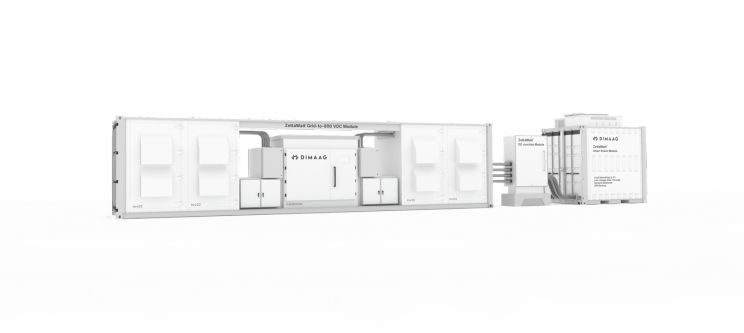
ZettaWatt moves battery backup from the conventional AC side of the facility onto the 800V DC bus.
When computing demand falls, the battery charges. When AI workloads suddenly increase, stored energy is discharged, reducing the speed and magnitude of changes visible to the electricity grid.
DIMAAG says the architecture also removes the need for separate supercapacitors and conventional backup battery systems.
“We have demonstrated an 800 V DC power system that smooths AI training-load fluctuations to less than 1% as seen by the grid,” said Ian Wright, CTO at DIMAAG.
300kW Demonstration Validates Architecture
The company has demonstrated ZettaWatt using a 300kW system at its Fremont, California headquarters.
Electric Power Engineers has also evaluated the system through PSCAD modelling, with simulations supporting its load-smoothing and low-voltage ride-through performance.
A key design advantage is efficiency. With only one AC-to-DC conversion between the grid and the DC backbone, the architecture is designed to reduce conversion losses compared with conventional double-conversion UPS configurations.
It also uses commercially available rectifiers and existing DIMAAG battery technology.
800V DC Moves Toward AI Infrastructure Standard
The broader data centre industry is already preparing for 800V DC architectures as GPU rack power densities increase. NVIDIA has also outlined an industry transition toward higher-voltage DC distribution for future AI factories.
DIMAAG is addressing a different but related challenge: making those facilities behave more predictably from the grid’s perspective.
If the architecture scales successfully from the current demonstration into hyperscale campuses, integrated batteries could become part of the electrical foundation of future grid-responsive AI data centres, rather than serving only as emergency backup.
Professionals at Dimaag: Sanjay Pichaiah Sadha Kameswaran Deepak Pingalay Satish Padmanabhan Shankar Radhakrishnan Senthil Pandurangan Pradeep Murali Shan Wan Maggie A. Ostrowski, PhD Ian Wright Sabarinath Jayaseelan Venkata Suharsha Thagaduru Roatchanatam (Bird) Anattasakul Vrushali Patil Jerrin Thomas