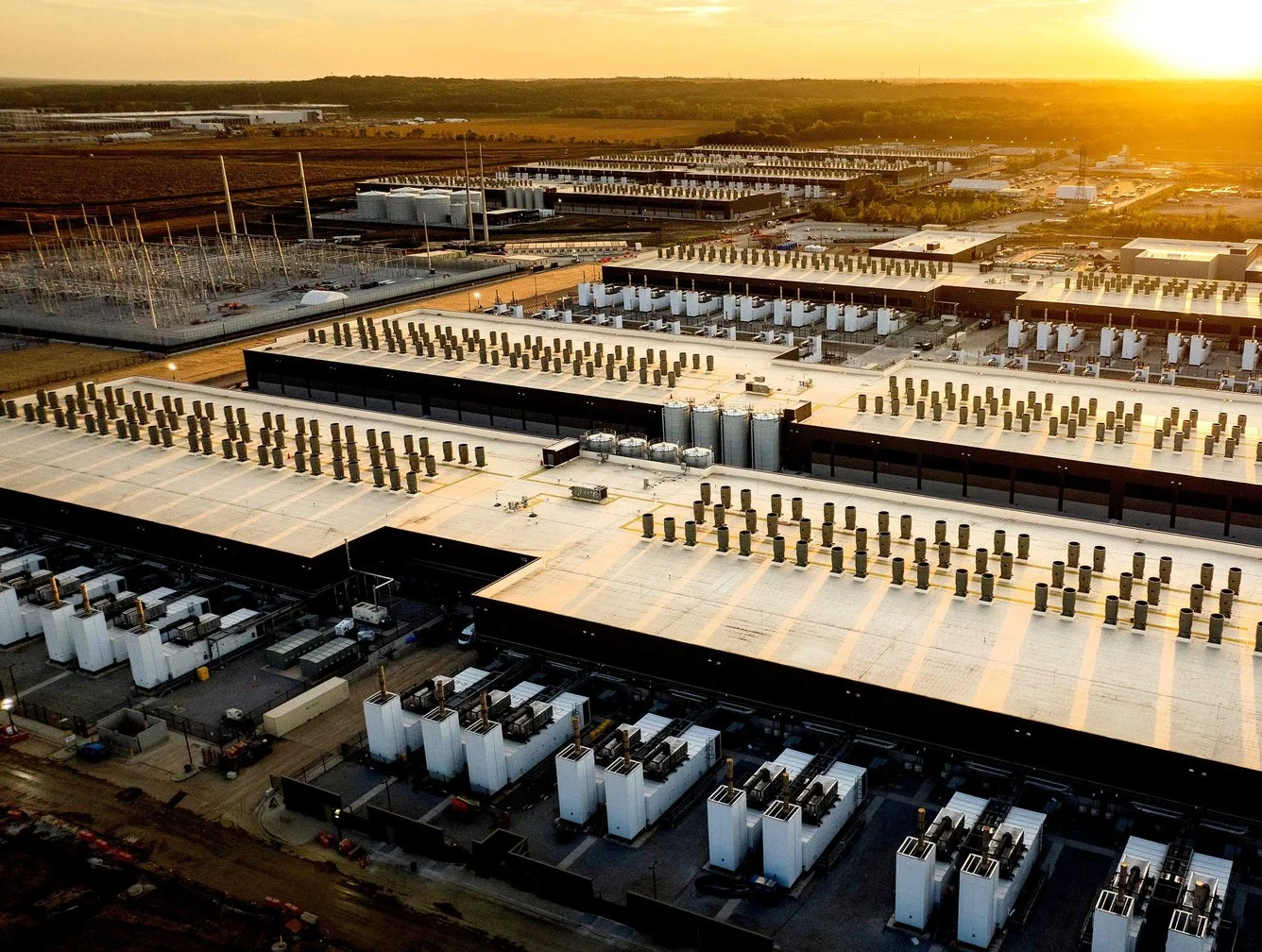
JLL says artificial intelligence is changing where hyperscale data centres are being developed across Europe and the Middle East. Operators are moving farther from established metropolitan hubs as access to electricity, development land and faster delivery pathways becomes more important than proximity alone.
Its EMEA Mid-Year Data Centre Report 2026 finds that hyperscale campuses planned for 2026–2028 sit an average of 175km from major hub cities, compared with 46km for projects delivered during 2022–2025.
Power Replaces Proximity as the Main Site Constraint
AI training environments can require sites of 100MW or more, larger electrical connections and higher-density cooling infrastructure. Unlike latency-sensitive cloud workloads, many training jobs can operate farther from large population centres. This allows developers to pursue locations where power and land are more readily available.
“Historically, operators built as close as possible to major population centres, but today’s growing AI training infrastructure follows a different logic.”
Assad Noori, Head of Data Centres, Work Dynamics EMEA at JLL
JLL reports that primary markets now command a significant powered-land premium over secondary and tertiary locations. Distance is therefore becoming one route to lower development costs, but only when sufficient electricity can be secured.
FLAP-D Capacity Continues to Expand
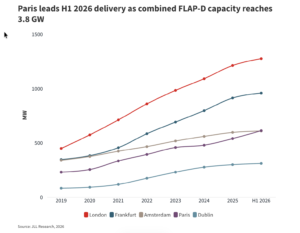
Frankfurt, London, Amsterdam, Paris and Dublin remain central to the European market. Combined live capacity has reached about 3.8GW, with another 1.4GW under construction and 2GW planned. JLL forecasts approximately 453MW of deliveries in 2026, while Paris delivered 72.5MW in the first half of the year.
Vacancy remains tight and long connection lead times continue to restrict supply. These conditions are encouraging capital to broaden into Milan, Iberia, the Nordics and other secondary markets without eliminating demand in the established hubs.
Greenfield Development Gains a Larger Share
Greenfield sites are expected to rise from 8% to 39% of the 2026–2028 pipeline. Larger, purpose-built campuses give operators more freedom to design power, cooling and connectivity systems around AI workloads rather than adapting constrained existing facilities.
In the Middle East, JLL identifies 2.6GW in development and 13.8GW in planning. The scale of that pipeline shows that the search for power-rich locations extends beyond Europe and is increasingly linked to sovereign-backed AI infrastructure programmes.
Europe’s Data-Centre Map Is Broadening
The report points to a market that is expanding geographically rather than abandoning its core. Primary hubs remain essential for latency-sensitive demand, while AI training is creating a second development pattern around power availability, large sites and construction certainty.
For developers and investors, the competitive advantage is shifting towards markets able to coordinate grid capacity, planning, land and infrastructure. That combination will determine which locations capture the next wave of hyperscale AI growth.